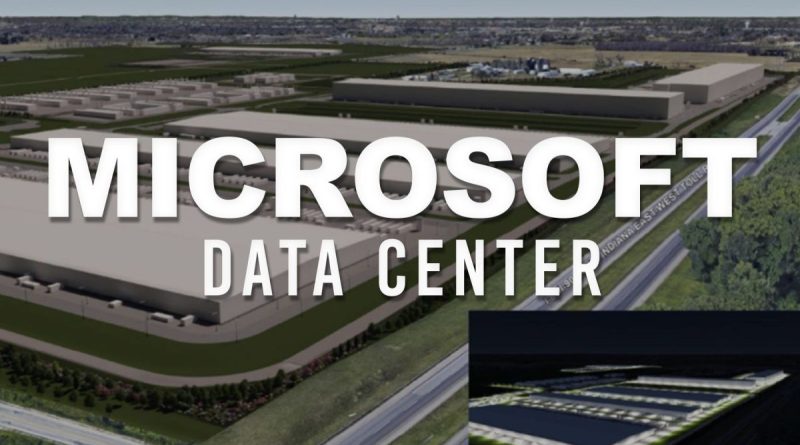
Microsoft’s Granger Data Center Moves Toward Vertical Construction as Road Projects and Community Debate Continue
GRANGER, Ind. — Microsoft’s massive data center development in Granger is approaching a major construction milestone, with steel expected to begin rising on the first building in early November. Meanwhile, millions of dollars in infrastructure improvements, upcoming road closures and calls for greater community investment are shaping the future of the project.
The development, located on the former St. Joe Farm property near Cleveland and Bittersweet roads, is expected to include five data center buildings north of Cleveland Road, with a possible sixth building south of the road.
In an exclusive interview with Penn News Network, St. Joseph County Economic Development Director Bill Schalliol provided new details about the project’s construction schedule, infrastructure investments and long-term plans.
“For the last several months, there’s been a variety of teams doing site work,” Schalliol said. “They’ve got, I think three of the pad sites leveled in at this point in time. And then we expect that early November, we’re going to start to see steel go up on the first building.”
Schalliol said the building closest to Bittersweet Road will be constructed first, with additional construction continuing across the property over the next several years.
Although six buildings have been proposed, the sixth remains uncertain.
“I think the sixth building really is kind of a long term play, whether or not they need it or will build it,” Schalliol said.
The county expects the first building to become operational around mid-2028. Hiring and workforce training could begin during 2027.
What exactly is a data center?
As construction progresses, questions remain about what data centers do and why technology companies are investing billions of dollars in these facilities.
Kyle Marsh, a robotics and computer science teacher at Penn High School, explained that data centers provide the physical infrastructure behind many digital services people use daily.
“Anytime we try to access something that’s not locally stored on our physical computer, we are relying on a cloud based storage system,” Marsh said.
Data centers contain servers, storage equipment and networking infrastructure used to store, process and distribute information. They support everything from online documents and streaming platforms to artificial intelligence applications.
Marsh said the growing popularity of streaming services and cloud computing has changed how people store information.
Rather than keeping music, movies and other files directly on personal devices, users increasingly access that content through online services.
“All of that data has to be stored somewhere and come from somewhere,” Marsh said.
Artificial intelligence has also contributed to increasing demand for computing infrastructure, although Marsh emphasized that data centers existed long before the recent AI boom.
“We’ve used data centers long before ChatGPT existed,” Marsh said.
Marsh also emphasized the importance of recognizing both the benefits and resource demands associated with these facilities.
“Yes. They consume massive amounts of electricity,” Marsh said, while also describing the growing reliance on digital infrastructure.
He encouraged students to research how data centers operate before forming conclusions about their effects on communities.
Major changes coming to Cleveland and Bittersweet roads
One of the most immediate impacts of the Microsoft project is the infrastructure construction taking place throughout northeastern St. Joseph County.
Schalliol said Cleveland Road is currently being widened from two lanes to three lanes to improve traffic flow and accommodate construction materials entering the development.
A new traffic signal is also planned at Cleveland and Currant roads.
Earlier county announcements discussed a broader four-lane improvement plan along Cleveland Road. However, Schalliol’s latest interview specifically described the current widening work as a two-to-three-lane project. The timing and extent of any additional widening remain unclear.
Meanwhile, Bittersweet Road will experience significant utility construction throughout the winter.
According to Schalliol, crews are preparing to install a water line beginning near Day Road, traveling along Gilman Drive and continuing north along the west side of Bittersweet Road toward Cleveland Road.
The water line is expected to be operational around April 2027, depending on construction conditions.
Additional water and sewer projects are being prepared along Cleveland and Douglas roads.
Schalliol said a separate sewer project along Bittersweet is planned for 2027, with the road expected to be reconstructed after the sewer installation.
“We’ll close Bittersweet and then put a sewer line down in the middle of Bittersweet and then rebuild the road as part of the project,” Schalliol said.
He expects that portion of the work to be completed sometime in late 2027.
Douglas and Bittersweet roundabout expected in summer 2027
Drivers who regularly travel through the four-way stop at Douglas and Bittersweet roads can expect a major change next summer.
Schalliol said the county plans to begin constructing a single-lane roundabout in June 2027, shortly after the school year ends.
The intersection is expected to close completely for approximately two months.
“June is when the intersection at Douglas and Bittersweet is going to be rebuilt, the roundabout,” Schalliol said.
The county hopes to reopen the intersection before students return to school in August.
Although the roundabout’s construction will overlap with Microsoft’s utility improvements, Schalliol clarified that the roundabout is a separate county project that has been planned for several years.
He said the timing allows the county to coordinate construction while minimizing disruptions.
Drivers should also expect temporary lane restrictions along Bittersweet during winter utility work. Weather conditions could affect the schedule.
Microsoft pledges millions for infrastructure
The scale of the development requires substantial investments in roads, water systems, sewer infrastructure and electrical service.
Schalliol said Microsoft has pledged nearly $63 million toward water, sewer, road improvements, engineering and property acquisition associated with the project.
“Locally, the county, city of Mishawaka have no money into the project. It’s all being paid for by Microsoft,” Schalliol said, referring to the infrastructure package.
Mishawaka will provide municipal water and sewer service to the property.
Schalliol also said the data center is designed to use a closed-loop cooling system, which he expects to limit its ongoing water consumption.
The county has been working with construction crews and local police to address traffic disruptions and dust concerns.
Schalliol acknowledged that dust was an issue during earlier stages of construction and said officials have worked to reduce those impacts.
We Make Indiana calls for a Fair Share agreement
While county officials emphasize infrastructure investment and potential economic benefits, a local community organization is seeking additional commitments from Microsoft.
We Make Indiana, a coalition of faith communities and local organizations, has launched a Fair Share campaign calling for a legally binding community benefits agreement.
Ryan Juskus, a representative of the organization, told Penn News Network that the campaign is focused on two major priorities.
The first is establishing enforceable environmental and operational standards addressing concerns such as water use, noise and electricity costs.
The second is securing ongoing financial contributions from Microsoft to support local needs, including housing, healthcare and public transportation.
“What we’re really seeking for Microsoft is to enter into negotiations with the community to create a fair share agreement,” Juskus said.
Juskus explained that the organization wants community members and county leaders involved in deciding how additional contributions would be used.
The organization has met with Microsoft representatives to present its proposal.
However, Juskus said the group had not received a substantial response at the time of his interview.
He emphasized that the campaign is not simply focused on stopping the development, which is already moving forward.
Instead, the organization wants Microsoft to establish a long-term relationship with the surrounding community.
Penn student joins the discussion
The Fair Share campaign has also drawn participation from students at Penn High School.
Addison Singleton, a Penn senior, has been involved with We Make Indiana for approximately a year and has worked on the Fair Share campaign for several months.
Singleton said the campaign developed partly in response to Indiana’s tax incentives for large data-center projects.
The student argues that companies benefiting from those incentives should make additional investments in the communities where they operate.
“We’re asking them to give back in some other equivalent way,” Singleton said.
Singleton acknowledged that the data center could create employment and educational opportunities, particularly for students interested in technology and skilled trades.
However, the student believes those opportunities should be part of a broader community investment strategy.
Singleton said the campaign’s immediate priority is getting Microsoft to negotiate directly with community representatives.
“You’re here, you need to listen to the voices of the people who are here,” Singleton said.
The campaign is also seeking participation from elected officials, community organizations and other local residents.
Potential jobs and educational opportunities
Beyond construction, the data center could create new career opportunities for workers in the region.
Schalliol said the county’s current understanding is that a fully developed six-building campus could employ approximately 600 permanent workers.
Those positions could include data technicians, electricians, plumbers, engineers and maintenance personnel.
However, the employment estimate depends on the number of buildings ultimately constructed and the facility’s operational needs.
The estimate also differs from earlier county announcements that projected approximately 300 permanent jobs.
Schalliol said Microsoft has been working with educational institutions on workforce development, including programs involving Ivy Tech Community College and local schools.
Training opportunities could involve data technology, fiber-optic systems and other specialized skills.
For Penn students, those programs could provide pathways into an industry that is expanding throughout northern Indiana.
Marsh noted that construction employment and permanent data-center employment are different.
Building a data center requires a large temporary workforce, but many construction jobs end once the facility is completed.
He encouraged students to understand those distinctions when evaluating the project’s economic impact.
A possible sound wall along the Indiana Toll Road
Another development that has received relatively little public attention involves Microsoft’s plans to address noise concerns.
Schalliol said Microsoft is expected to seek approval from the St. Joseph County Board of Zoning Appeals in November for a sound wall along the northern edge of the campus.
The proposed wall would extend approximately from Currant Road to Bittersweet Road, near the Indiana Toll Road.
According to Schalliol, the wall is intended to reduce noise and visually separate the development from neighborhoods to the north.
He said concerns about noise were among the issues raised by nearby residents.
The wall still requires the applicable zoning approval, and detailed plans have not yet been publicly confirmed in this report.
Debate continues over future tax revenue
Another major issue involves the possibility of placing the Microsoft development within a tax increment financing district, commonly known as a TIF district.
A TIF district captures certain increases in property tax revenue within a designated area and directs those funds toward eligible improvements.
Schalliol said the county wants to use future tax revenue generated by the development for infrastructure and community projects in northeastern St. Joseph County.
Potential projects discussed include additional water and sewer extensions, sidewalks, parks, school partnerships and a possible railroad overpass along Douglas Road.
The proposed district has generated disagreement among local officials and residents, particularly over whether the infrastructure could encourage additional commercial or industrial development in Granger.
Schalliol said discussions were expected to resume after the November election.
The proposal remains a separate policy question from the construction work already underway.
What happens next?
Several important milestones are approaching.
The county expects steel construction on the first Microsoft building to begin in November, with utility installation continuing through winter.
Water infrastructure is expected to reach a major operational milestone in spring 2027.
The Douglas and Bittersweet roundabout is expected to begin construction in June 2027, requiring an approximately two-month intersection closure.
The first data center building could become operational around mid-2028, with additional buildings developed over the following years.
Meanwhile, Microsoft is expected to seek approval for the proposed northern sound wall, and county officials will continue discussing how future tax revenue from the development should be used.
For Schalliol, the project represents an opportunity to expand infrastructure and bring new employment to the area.
For We Make Indiana and participating students, the focus remains on ensuring that the development’s long-term benefits extend beyond the data-center property.
And for residents who travel Cleveland, Douglas and Bittersweet roads, the changes are already becoming visible.
As construction progresses, the full impact of Microsoft’s investment on Granger and the surrounding community will continue to unfold.
